


By Admin on Oct 26, 2026
 Luminus
Why we created this report
No consumer market in the Netherlands is easier to leave than energy. A household can compare the whole market in a few minutes, switch on a price difference and be with a new supplier within a month. In 2025, 15.1% of Dutch households did exactly that.
A market that loses and replaces customers at that rate relies heavily on how well it can onboard, recognise and keep them. Yet most suppliers still treat identity as a simple form, a bank account number and a password.
The Identity Maturity Index 2026 measures how far that experience falls short: not the strength of one login screen, but whether a customer’s verified identity can be used across registration, login and signing, or it needs to be rebuilt at every step.
What the study measured
NIQ surveyed Dutch and Belgian consumers on how their providers handle identity, including 508 Dutch energy customers. For each identity moment, participants said two things: which method their supplier uses today and what they would prefer to use as a customer. The first became the maturity score and the second became the importance score, both scored on a scale from 0 to 100. The distance between them is the demand that energy suppliers are not meeting.
Here are the main findings for the Dutch energy sector:
- Dutch energy scores 36 on identity maturity against a customer importance of 80 to 83 at every touchpoint
- This is the lowest score in the entire Index
- No individual Dutch supplier is pulling ahead
- 57% of Dutch energy consumers want an external ID app as the standard way to confirm a new customer’s identity
- Belgian energy scores 54 on maturity, an 18-point lead that is the largest cross-border difference in the Index
A revolving door with a price tag
Insurance concentrates its churn into an annual renewal window and telecom can hold customers inside contract terms and handset subsidies. Energy has neither of those brakes, so suppliers buy their growth instead.
Two years ago, 12 suppliers offered a welcome bonus. Today this number is up to 20 and four in ten contract offers carry one, reaching up to €688 on a one-year fixed contract. Add the comparison platform’s commission and the marketing behind the click and every new customer arrives with a known, rising, up-front cost. That customer can then leave again on a price change a year later.
All of that money is committed before a customer has even been verified. Because a supplier that onboards through a form and a bank account number has a mere billing relationship.
What the identity gap costs
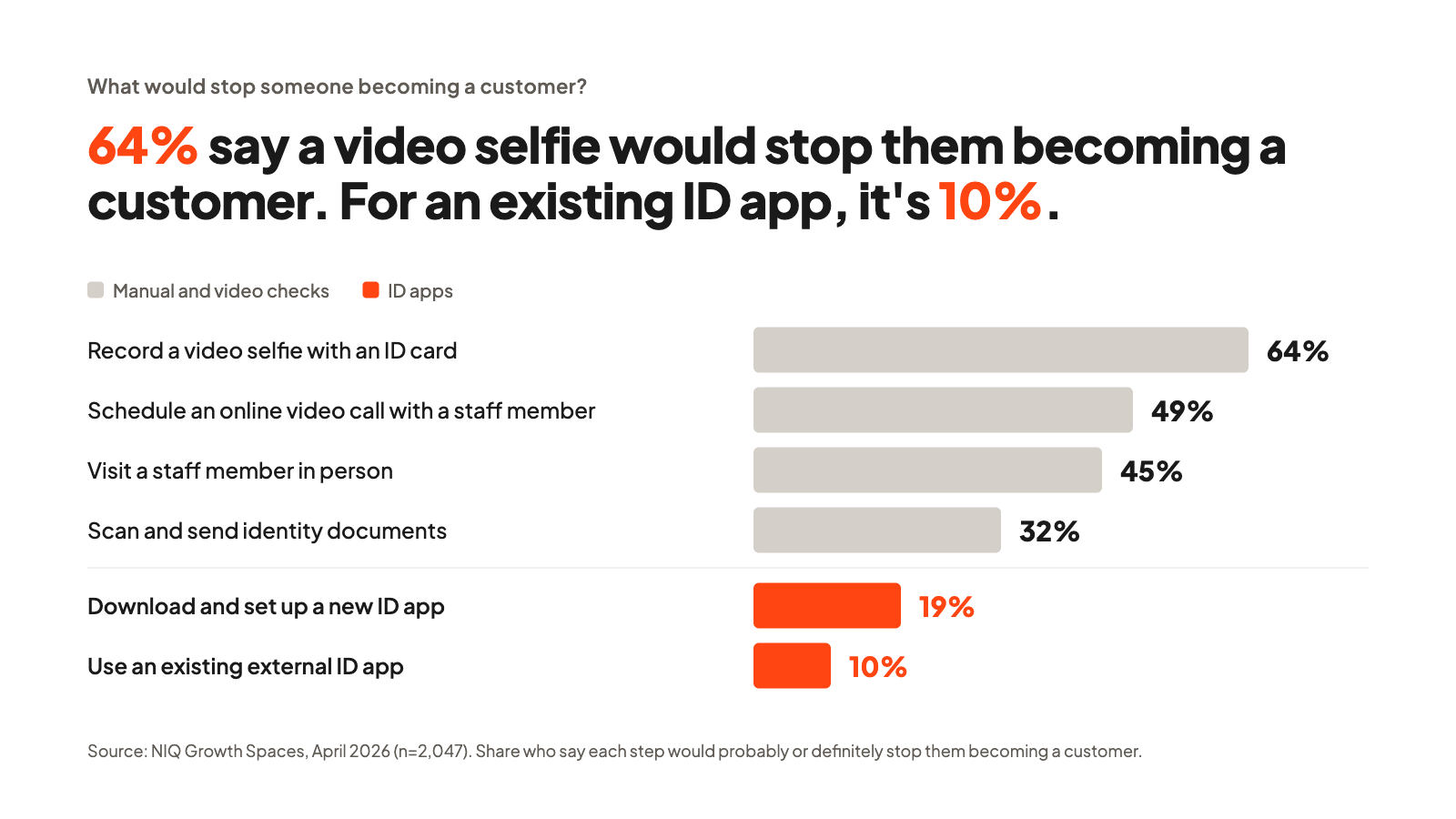
When a household gives up during the identity verification process, energy suppliers lose more than a sign-up. The welcome bonus, the comparison platform’s commission and the marketing spend that brought that household in are lost too.
 Barriers chart 16 9@1x
But that’s not the only identity cost. A weak login experience is also expensive. On average, a single password reset costs around $70 and a customer who can’t get into their account to check a bill or submit a meter reading can switch to another supplier in a few minutes.
Weak onboarding also makes fraud harder to deal with. If a contract was signed with just a name and an address, it’s hard to prove who actually agreed to it. And if customer data leaks, the bill is steep: the average data breach now costs $4.44 million.
These costs are easy to miss because none of them are labelled “identity”. They show up as lower conversion, busier call centres, fraud losses and customers who leave.
Why this matters in 2026
On 1 January 2026, the Energiewet came into force, tightening the rules on contracts, exit fees and who can consent to sharing a household’s energy data. All of it assumes energy suppliers can prove who agreed to what.
Every EU member state must also make a digital identity wallet available by the end of 2026. The first regulatory wave is directed at public services and banking, with energy following behind, which gives Dutch suppliers a window where reusable identity is still a competitive decision rather than a compliance obligation.
Around 8 million people in Belgium already use itsme to prove who they are to their bank, insurer, telecom and energy providers, and government. itsme launched in the Netherlands in June 2026 at eIDAS Level of Assurance High, covering identity verification at registration, passwordless login, qualified electronic signature and transaction confirmation. No Dutch supplier has made a move yet, so whoever goes first sets the benchmark.
 UseCase_DocumentSigning
Read the full Energy Report
The full Identity Maturity Index 2026 Energy Report places Dutch suppliers on the maturity curve, with the touchpoint-by-touchpoint data behind every figure above. Inside, you’ll find:
- The full maturity-versus-importance breakdown for every energy touchpoint
- How Dutch suppliers compare with Belgium
- The fragmentation tax, broken down cost by cost
- What the Energiewet means for identity and the way forward
Download the Identity Maturity Index 2026 Energy Report
 1746470205-blogpost_1880x987-telecom-1
The identity gap in Dutch telecom: insights from the Identity Maturity Index
 insurance
The identity gap in Dutch insurance: insights from the Identity Maturity Index
 Woman In Orange Dress Standing Out Amidst Blurry Crowd